Developer Projects
Explore public projects, their source code, demos, and tools. Sign in to draft your own project, then choose when to publish it.
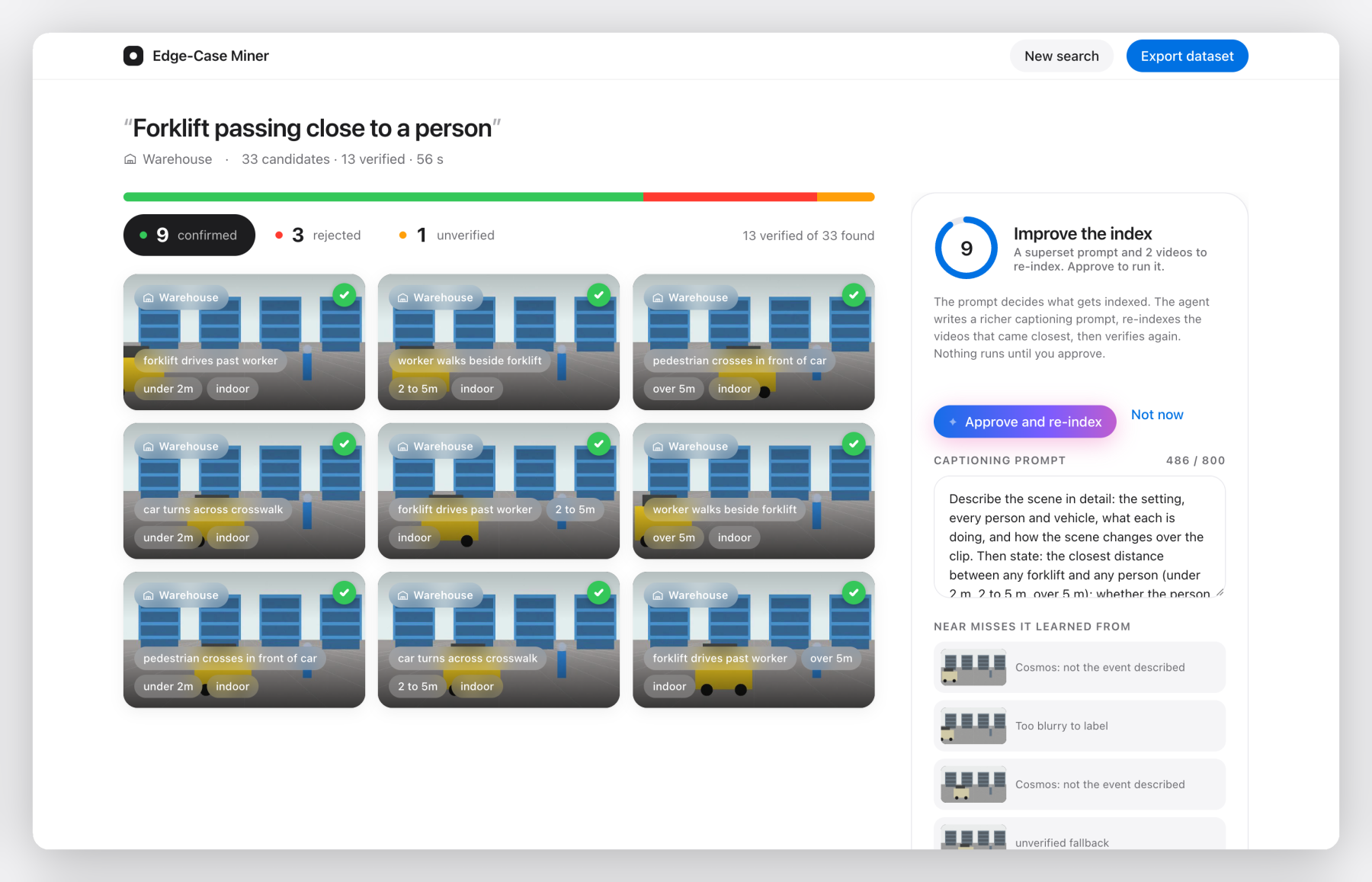
Edge-Case Miner is a tool for robotics and self-driving teams that have hours of camera footage but no time to label it. You type a request like "forklift passing close to a person" and pick which cameras to look at. The tool searches the whole video archive for likely matches, then plays each candidate clip to a video-understanding model that answers yes or no and fills in labels such as who is in the shot, what they are doing, how close they are, and the lighting and weather. Clips that fail the check are rejected with a reason, so nothing gets into the dataset on a caption match alone. Every confirmed clip also gets a quality score based on object detection, blur, and whether the whole event is visible. At the end you get a zipped dataset with the clips, a labels file, and a dataset card, plus a coverage report that shows which situations you have plenty of and which you are missing, with a plan for what to film next. If too few clips pass, the tool proposes a better indexing prompt and, once you approve, re-indexes the closest chunks and searches again.
Listed tools (4)
Scroll for more VAST DataEnterprise AI data platform combining storage, databases, vector search, and event-driven data pipelines.
 SpaceXAI (Cursor)pendingAI Dev Platforms tool
 CoreWeave (Weights & Biases)pendingAI Dev Platforms tool
 NVIDIANVIDIA provides developer tools, SDKs, documentation, and training for AI and accelerated computing.
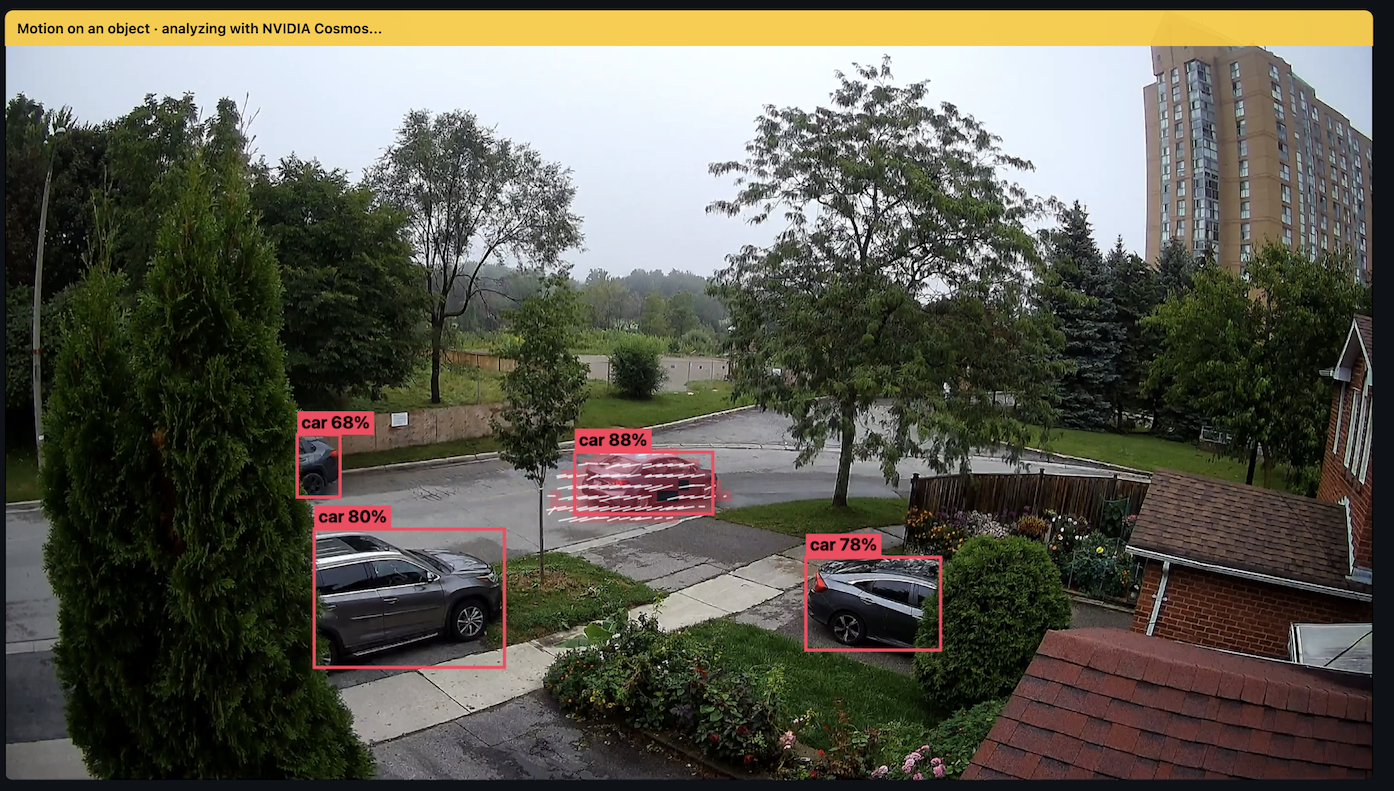
A lot of video footage is surprisingly static, and running a full interference sweep on unchanging frames is a waste of precious GPUs. We're optimizing the pipeline by using codec motion vectors, used for video codec compression, to crudely detect motion for free. This is a simple heuristic that gates a full YOLO run on the entire frame, saving up to 70% for low motion scenes, but could easily be extended to specific regions of the video and more expensive models. Everything uses my open source real-time media transport (moq.dev) allowing the AI model to only run on demand, saving even more money for rarely monitored security footage. YOLO is running on my desktop PC at home so I can process individual frames. It's connected to my global CDN (moq.pro) which it uses to both fetch the camera footage and publish the AI detection results (as a track). The web player subscribes to tracks on demand based on the camera selected and options. We emulate live footage using VAST's sample videos slowly tricked over the network (ffmpeg -re) and everything is real-time. Object detections and motion vectors (extracted by the desktop) trail the footage by at least 2 frames (plus RTT) because we intentionally don't synchronize the sources. Real-time latency is critical for some use-cases, like drones, so we felt it would make a more honest demo.
Listed tools (3)
- CoreWeave (Weights & Biases)pendingAI Dev Platforms tool
- NVIDIANVIDIA provides developer tools, SDKs, documentation, and training for AI and accelerated computing.
- SpaceXAI (Cursor)pendingAI Dev Platforms tool
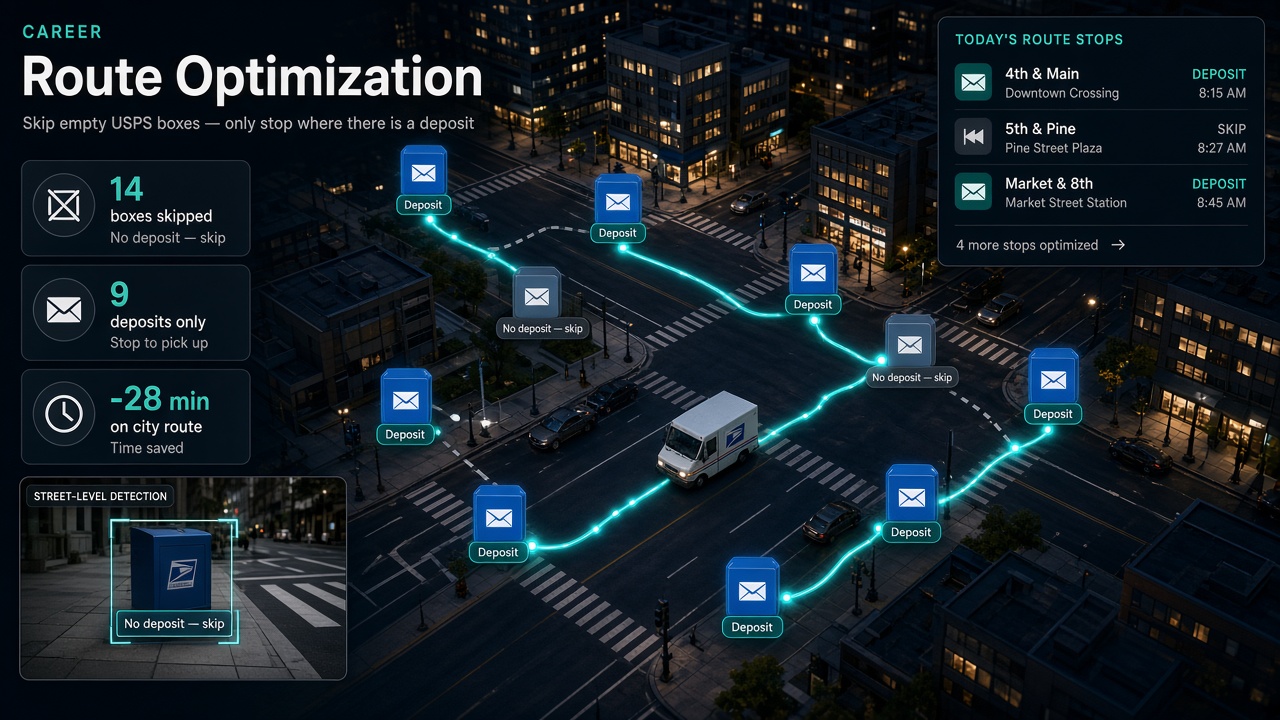
We built a carrier route optimizer that uses indexed video to tell which mailboxes have a deposit and which are empty. Carriers skip empty boxes and only stop where there is mail to drop. The result is a shorter daily route without guessing from the sidewalk.
Listed tools (4)
Scroll for more- SpaceXAI (Cursor)pendingAI Dev Platforms tool
- VAST DataEnterprise AI data platform combining storage, databases, vector search, and event-driven data pipelines.
- CoreWeave (Weights & Biases)pendingAI Dev Platforms tool
- NVIDIANVIDIA provides developer tools, SDKs, documentation, and training for AI and accelerated computing.
Listed tools (1)
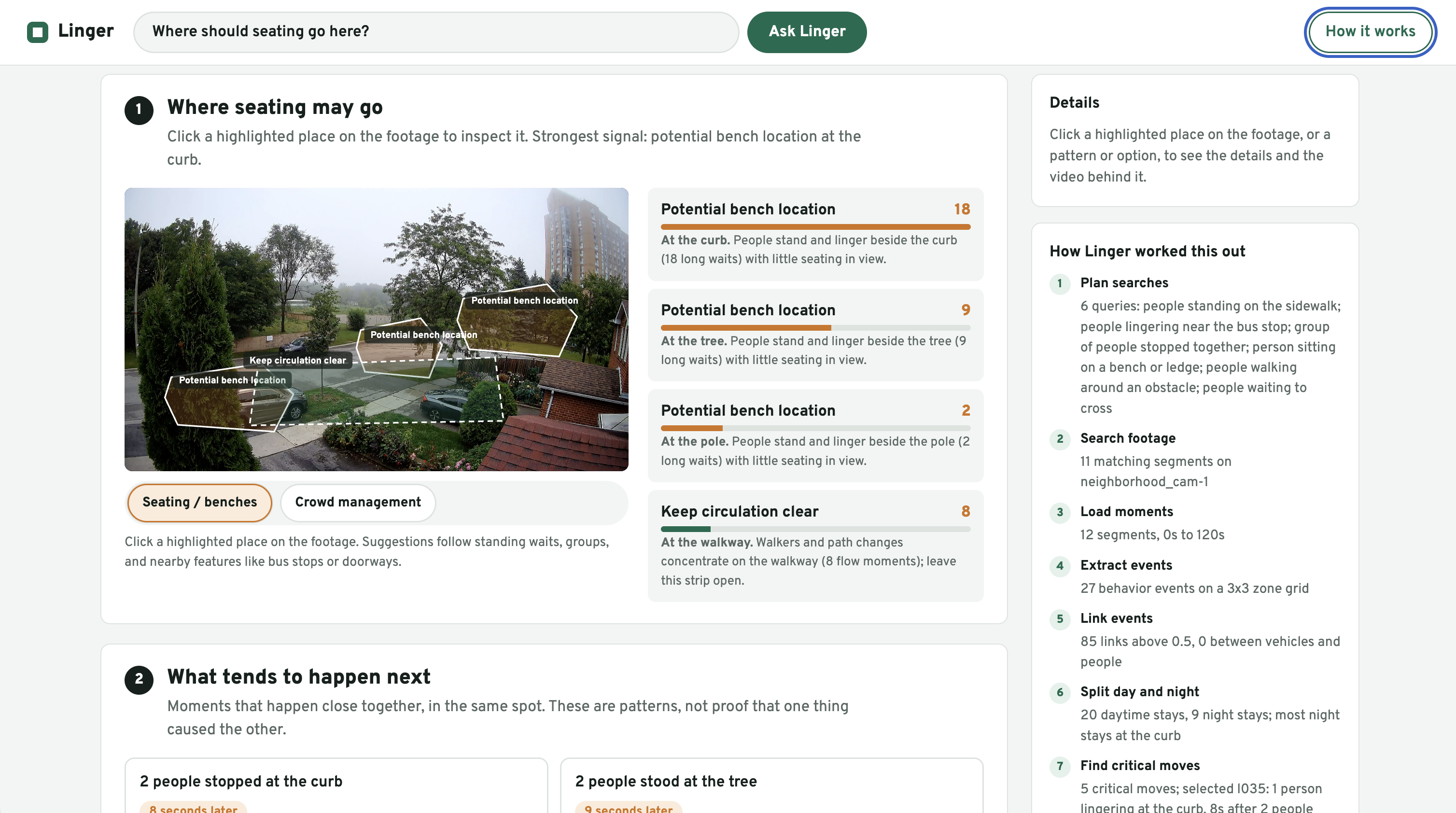
Where should the bench go? Designers answer that by watching a plaza for weeks or scrubbing hours of footage, like William Whyte did. Most streets never get that attention, so seating, lighting and bus stop decisions get guessed. Linger is video agent that does this observation at scale. It scans ever camera in the VAST video library, ranks the places where people stop, wait and gather (linger), and lets a planner explore one: where people stop by day and night, what tends to happen next (a bus arrives, then a group forms where it stopped), and three plausible futures, like seating or lighting, each citing the real clips behind it. We re-ingested the footage with a behavior-only prompt, so NVIDIA Cosmos3-Reason never records faces, identity, or clothing. YOLO11 detects people and vehicles on CoreWeave GPUs. The agent reasons with W&B Inference, traces every step in Weave, and a Weave evaluation checks it never cites a missing clip or claims cause. Built for planners, transit agencies and campuses: weeks of observation in an afternoon, backed by evidence anyone can watch.
Listed tools (4)
Scroll for more- VAST DataEnterprise AI data platform combining storage, databases, vector search, and event-driven data pipelines.
- SpaceXAI (Cursor)pendingAI Dev Platforms tool
- CoreWeave (Weights & Biases)pendingAI Dev Platforms tool
- NVIDIANVIDIA provides developer tools, SDKs, documentation, and training for AI and accelerated computing.
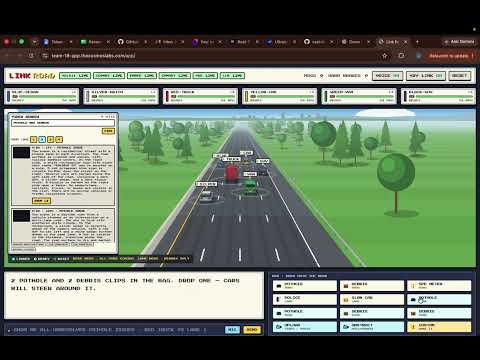
We use Nvidia Cosmos reasoner model and YOLO object detection to quickly detect objects. The Cosmos reasoner model then analyses the scene and then reasons out the whole scenario: whether there is a pothole, how deep the pothole is, which vehicle parts can be damaged because of this pothole, etc and then the whole thing is communicated to near by vehicles. We create a memory map of the whole city.
Listed tools (4)
Scroll for more- VAST DataEnterprise AI data platform combining storage, databases, vector search, and event-driven data pipelines.
- NVIDIANVIDIA provides developer tools, SDKs, documentation, and training for AI and accelerated computing.
- CoreWeave (Weights & Biases)pendingAI Dev Platforms tool
- SpaceXAI (Cursor)pendingAI Dev Platforms tool
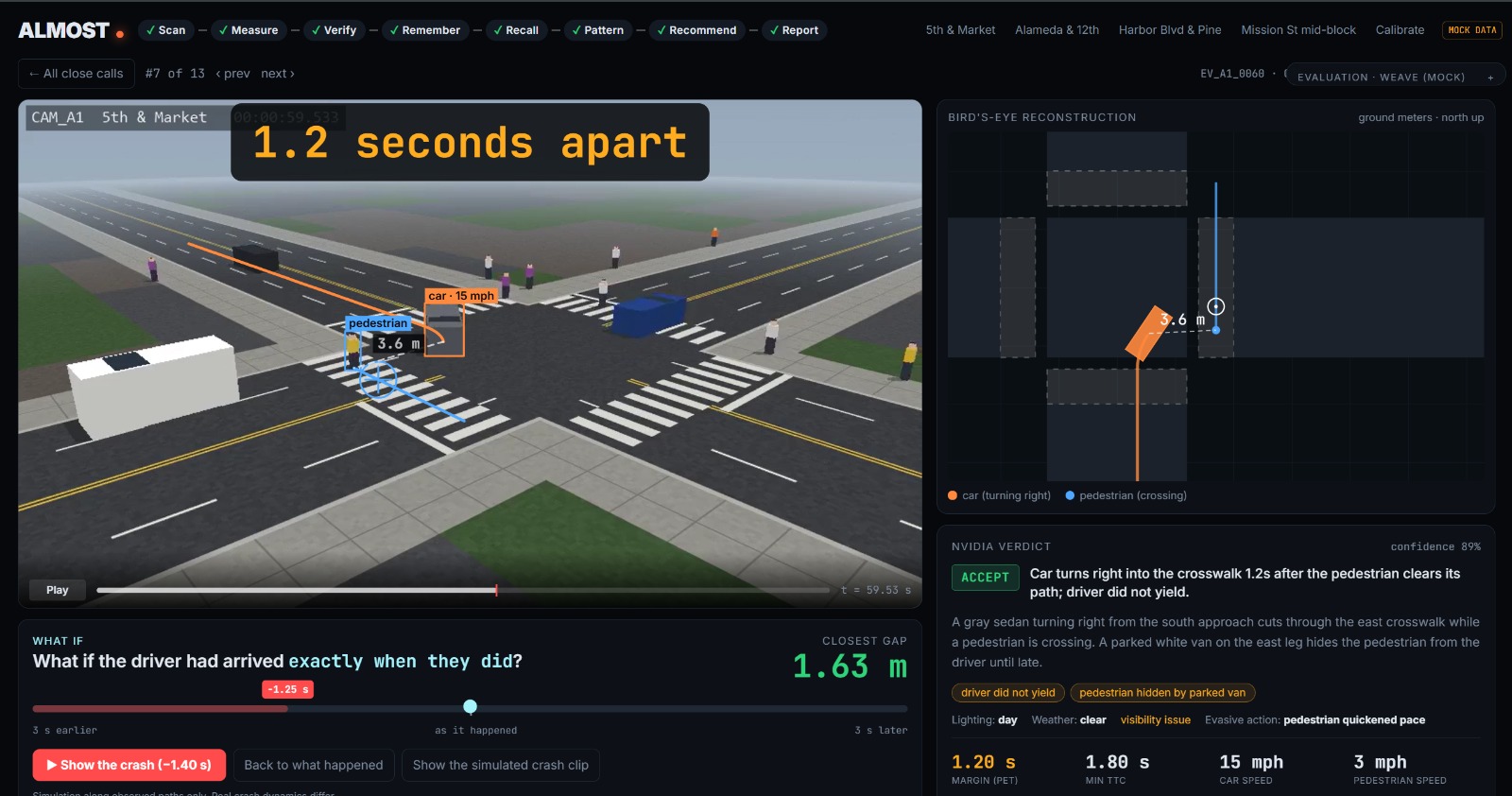
Someone almost gets hit today. They walk home, so it never becomes a report. Tomorrow it happens again, until one day it ends differently. 39,345 people died on US roads in 2024, and the warnings came first: near misses buried in hours of camera footage nobody watches. LookOut is an autonomous investigator for street cameras. Press one button and it: - Tracks every pedestrian, cyclist and vehicle with YOLO - Measures each interaction in seconds (post-encroachment time and time to collision) - Verifies every close call with NVIDIA Cosmos, rejecting false alarms and explaining what happened - Remembers everything in VAST, recalling similar events across cameras and time to prove the danger isn't isolated - Finds the recurring pattern with W&B and recommends FHWA Proven Safety Countermeasures, each linked to FHWA and the exact clips that justify it - Simulates the crash that almost happened: drag the WHAT-IF slider and see what 0.7 seconds of luck really meant Every step is traced and evaluated in W&B Weave, and every claim links back to video. Recommendations are for engineers to review, not automatic decisions. Crash reports show where people got hurt. LookOut shows where they almost did, so the next one never has to.
Listed tools (4)
Scroll for more- VAST DataEnterprise AI data platform combining storage, databases, vector search, and event-driven data pipelines.
- CoreWeave (Weights & Biases)pendingAI Dev Platforms tool
- NVIDIANVIDIA provides developer tools, SDKs, documentation, and training for AI and accelerated computing.
- SpaceXAI (Cursor)pendingAI Dev Platforms tool
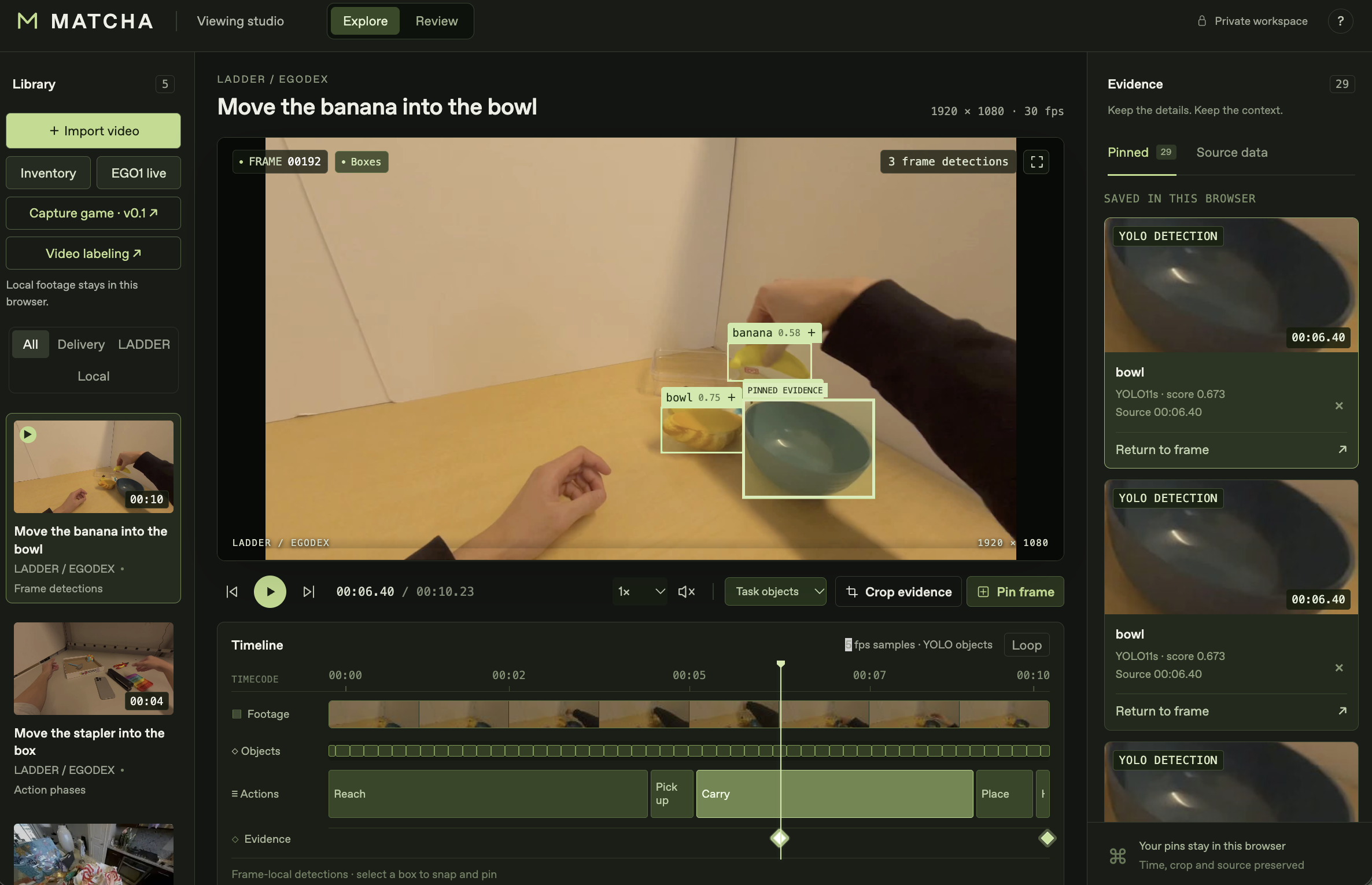
Robotics research needs datasets with verifiable diversity across environments, objects and actions. **MATCHA** helps **researchers** turn video archives into **curated**, **labeled datasets** for **training** and **evaluation**. Researchers describe the footage they need in plain language, inspect matching clips and objects at scale, identify coverage gaps and overrepresented scenarios, and edit labels in bulk. By making dataset composition visible and measurable, MATCHA helps teams build balanced datasets and export versioned collections with clear annotations and documented coverage. app password is: theyarecoming
Listed tools (4)
Scroll for more- VAST DataEnterprise AI data platform combining storage, databases, vector search, and event-driven data pipelines.
- SpaceXAI (Cursor)pendingAI Dev Platforms tool
- CoreWeave (Weights & Biases)pendingAI Dev Platforms tool
- NVIDIANVIDIA provides developer tools, SDKs, documentation, and training for AI and accelerated computing.
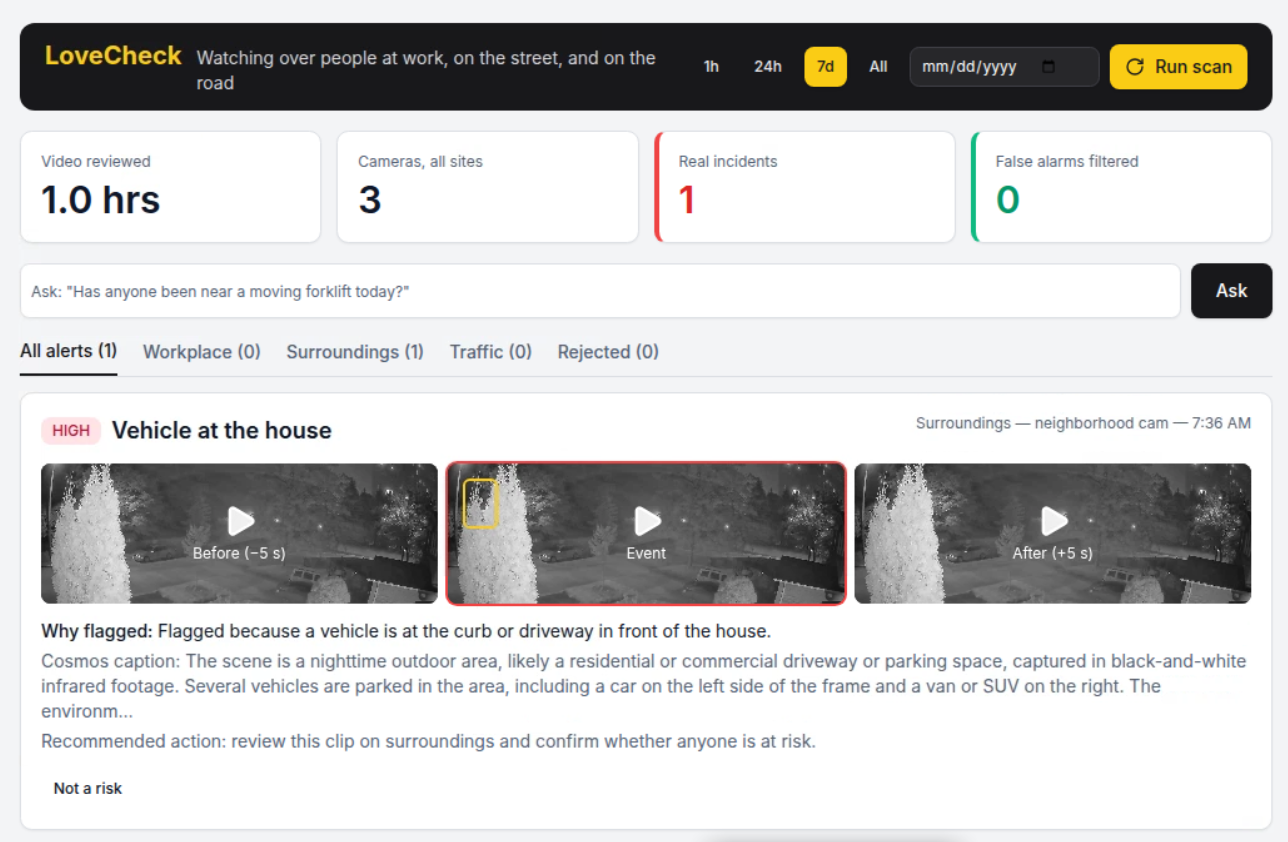
LoveCheck is a three-site safety board: warehouse, neighborhood, and dashcam. It looks at those cameras and shows a few clips where someone might be at risk. The UI is Next.js. Flask talks to team Video Search with credentials kept on the server, so the browser never sees login tokens. It finds the latest footage, searches for hazards, drops near-duplicate chunks, and streams the clip through our own proxy.
Listed tools (3)
- VAST DataEnterprise AI data platform combining storage, databases, vector search, and event-driven data pipelines.
- SpaceXAI (Cursor)pendingAI Dev Platforms tool
- NVIDIANVIDIA provides developer tools, SDKs, documentation, and training for AI and accelerated computing.
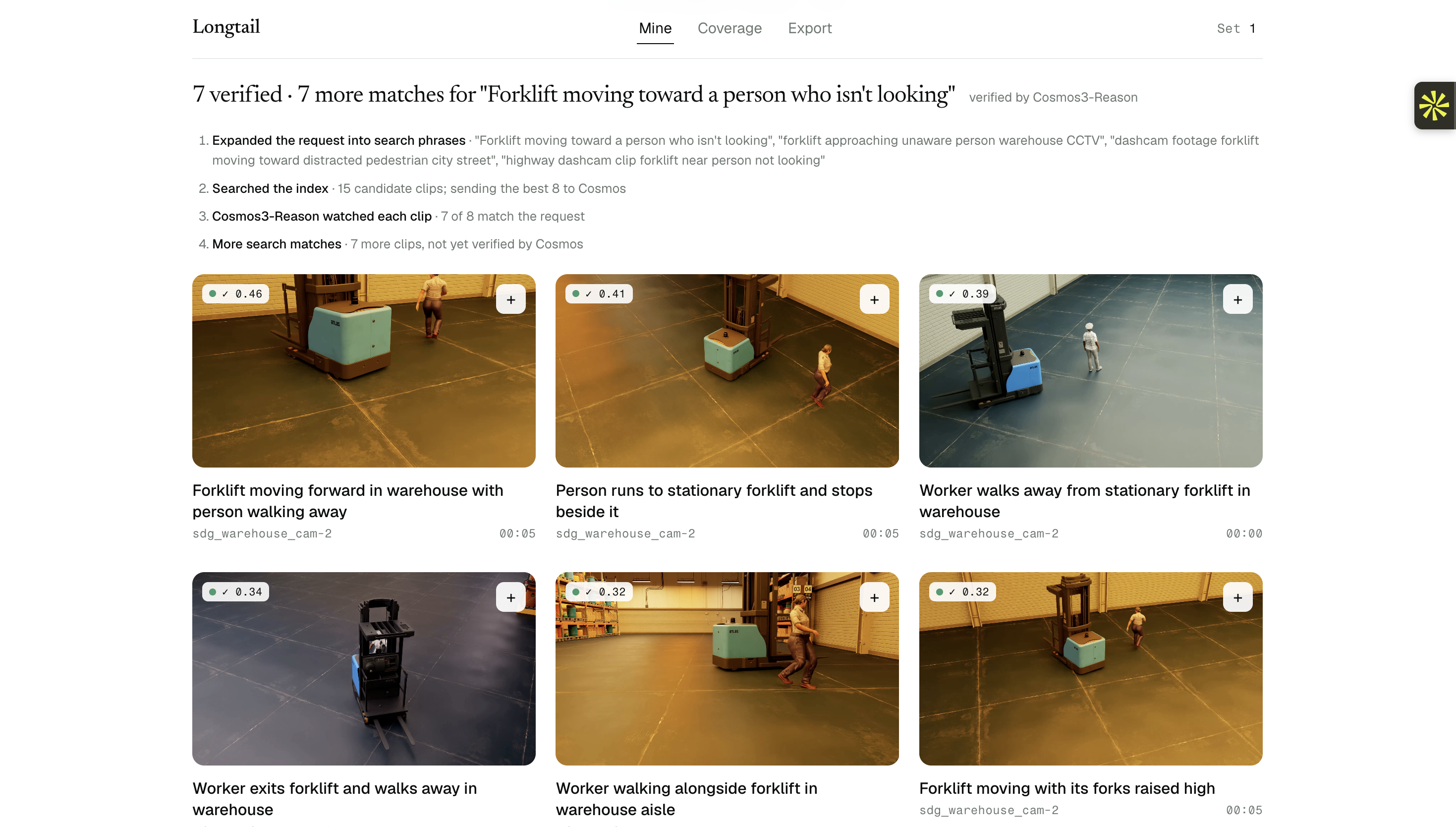
Self-driving cars and warehouse robots rarely fail on everyday scenes. They fail on rare moments like a pedestrian stepping out from behind a van or a worker beside a moving forklift, and those moments are buried in hours of unwatched video. Longtail is a video agent that finds them. You describe a corner case in plain English, and the agent: - expands it into several searches - searches the indexed footage three ways: VAST's hybrid search, our own Cosmos-Embed index, and YOLO object detections - has NVIDIA Cosmos3-Reason watch the best candidates and keep only real matches Results are ranked by danger (Cosmos's rating) and rarity (embedding distance within each camera pack). Each clip comes with a structured scenario label, "find similar" turns one example into a set, and a coverage map shows which situations are missing and lets the agent fill those gaps. Every run exports a training-ready JSON with clip IDs and start/end times, or a versioned Weights & Biases dataset. It works across real dashcam, highway and street cameras and synthetic warehouse footage.
Listed tools (4)
Scroll for more- VAST DataEnterprise AI data platform combining storage, databases, vector search, and event-driven data pipelines.
- SpaceXAI (Cursor)pendingAI Dev Platforms tool
- CoreWeave (Weights & Biases)pendingAI Dev Platforms tool
- NVIDIANVIDIA provides developer tools, SDKs, documentation, and training for AI and accelerated computing.
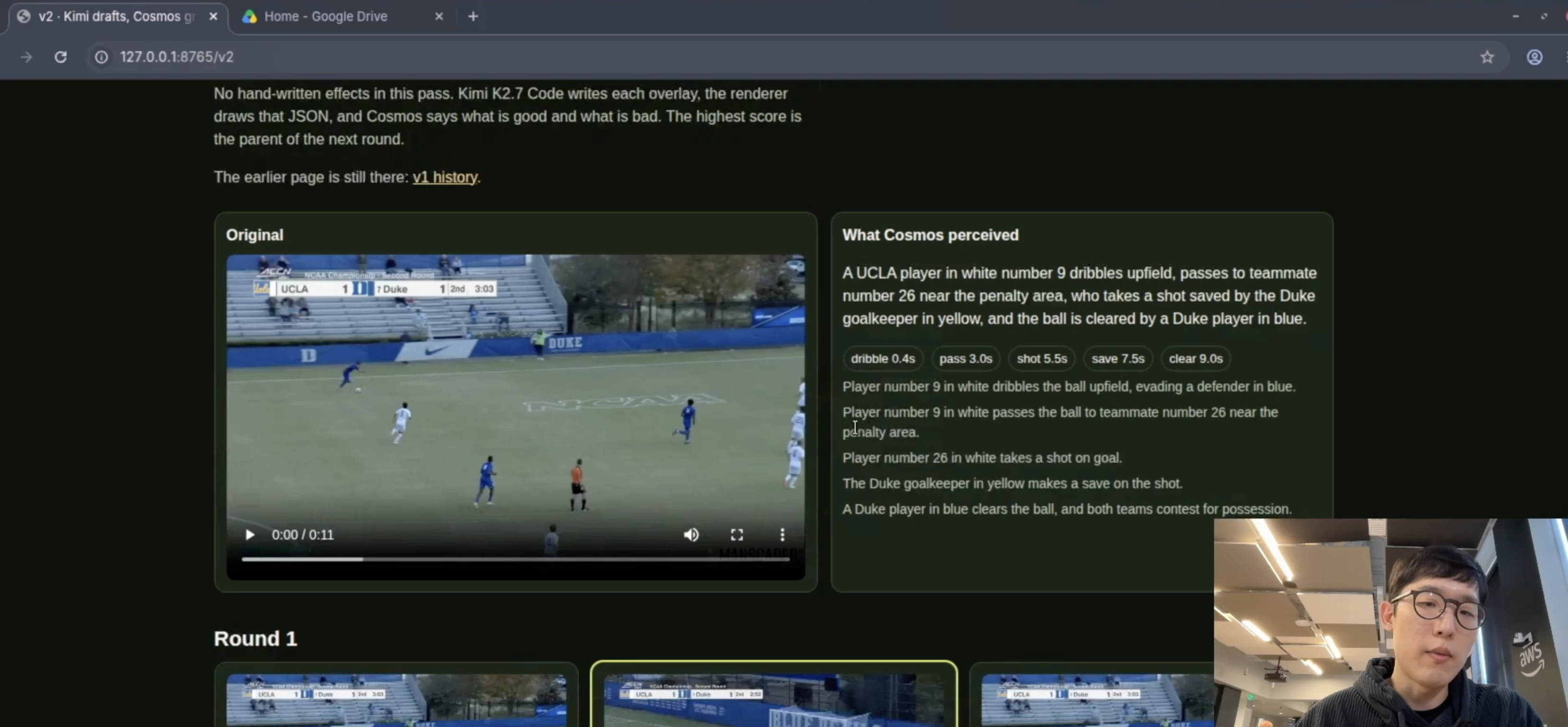
Hype Agent is a video agent that turns a raw, wide-angle soccer clip into a highlight people want to watch. The clip is ingested on VAST AI OS and indexed with NVIDIA's VSS blueprint, which gives YOLO detections on every frame, and Cosmos Reason reads the frames to find the story. In our demo clip, Duke's #8 beats a defender one-on-one, strikes on frame 220 and scores past a diving keeper. The agent tracks the ball on every frame and writes an edit plan: speed ramps, freeze frames, slow motion, camera zooms and tilts, fire trails pinned to the real ball, player tags, text slams, and sound effects synthesized from code and timed to the action. It renders the cut, re-watches it frame by frame along with the audio waveform, critiques what's weak (a slow opening, a muddy picture, dead air, cluttered text), and revises the plan. After five loops a flat clip becomes a 19-second edit with a cold open, a slow-motion replay and audio mastered to social-media loudness, with no human editor involved.
Listed tools (4)
Scroll for more- VAST DataEnterprise AI data platform combining storage, databases, vector search, and event-driven data pipelines.
- SpaceXAI (Cursor)pendingAI Dev Platforms tool
- NVIDIANVIDIA provides developer tools, SDKs, documentation, and training for AI and accelerated computing.
- CoreWeave (Weights & Biases)pendingAI Dev Platforms tool
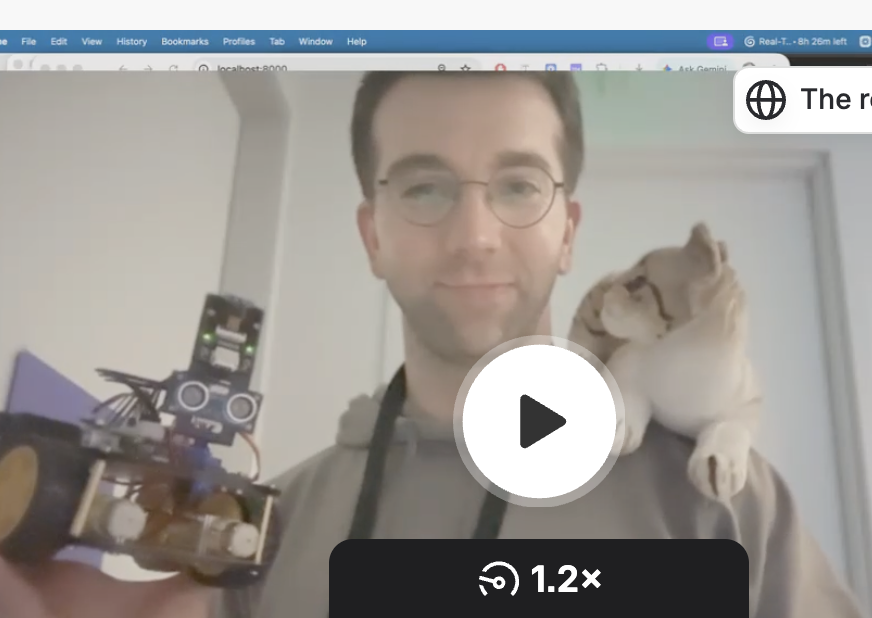
A small robot mouse with a camera which is rightfully terrified of cats. It patrols the room. When NVIDIA Cosmos Reason (cosmos3-nano-reasoner, served on CoreWeave GPUs) sees a cat in the live feed, the car panics: red lights, a 540 degree spin and a sprint away, with a panic clip on the dashboard. When Cosmos sees a hot dog, the car flashes green, and approaches. Every 5-second clip the robot records goes into the event's VAST AI OS video pipeline, where DataEngine runs YOLO11, Cosmos captions and Cosmos-Embed1 into VastDB (756 clips so far). So the robot can answer plain-language questions about its own life: "when did the cat get closest, and did I get away?" comes back with an answer and the matching clips. A Llama 3.3 70B planner on WandB Inference narrates what the robot is doing. Reflexes (steering, a 25 cm wall check, a disconnect watchdog) run on the laptop and never wait on the cloud; YOLO11 is the offline fallback detector. For anyone with a pet camera, a security feed or a robot: video that can be searched and acted on instead of sitting unwatched.
Listed tools (4)
Scroll for more- VAST DataEnterprise AI data platform combining storage, databases, vector search, and event-driven data pipelines.
- CoreWeave (Weights & Biases)pendingAI Dev Platforms tool
- NVIDIANVIDIA provides developer tools, SDKs, documentation, and training for AI and accelerated computing.
- SpaceXAI (Cursor)pendingAI Dev Platforms tool
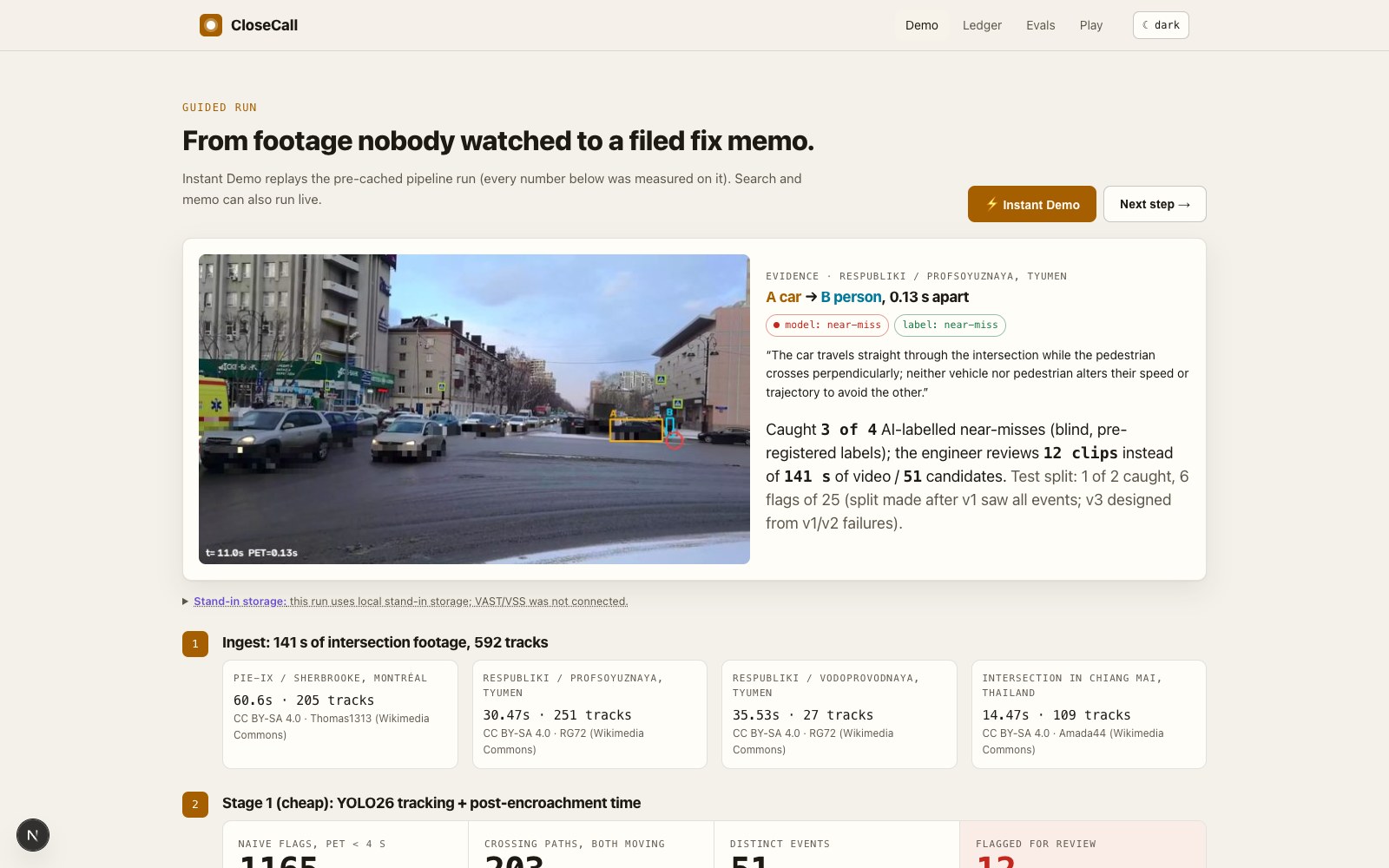
**For city traffic engineers. Today an intersection only "counts" as dangerous once someone is hurt, because crash reports are the only evidence a council accepts. Meanwhile, the cameras already record every close call, and nobody watches them.** **What CloseCall does:** **Track:** Ultralytics YOLO26 tracks every road user. Post-encroachment time (PET) under 4 s flags a conflict, and a physics filter keeps only real crossing paths. Detected heads and plates are pixelated before any model sees a frame. **Triage: **each candidate becomes an 8-frame storyboard, and three open models (Qwen, MiniMax, Gemma) on W&B Inference on CoreWeave vote; two of three must agree. Every vote is traced in W&B Weave. **Search:** NVIDIA Nemotron embeddings let the engineer search in plain words ("turning car cutting across a pedestrian"). Identity questions are refused. **Act: **NVIDIA Nemotron-3.5 Lightning drafts a fix memo in which every claim cites a clip id, and a council-packet CSV export (built with Cursor) goes to the meeting. **Play:** "Spot the Near-Miss", a 10-round game: you vs the 3-model vote vs the label. **Measured, not claimed:** from 141 s of footage, 1,165 raw flags → 51 candidates → 12 clips to review. The vote caught 3 of 4 labelled near-misses across all 51 events, and 1 of 2 on held-out events (blind, pre-registered labels; every step is in the repo). A VAST VSS client is built behind a storage adapter, ready to connect.
Listed tools (5)
Scroll for more- NVIDIANVIDIA provides developer tools, SDKs, documentation, and training for AI and accelerated computing.
- CoreWeave (Weights & Biases)pendingAI Dev Platforms tool
- SpaceXAI (Cursor)pendingAI Dev Platforms tool
- VAST DataEnterprise AI data platform combining storage, databases, vector search, and event-driven data pipelines.
- Ultralytics YOLO26pendingAI Dev Platforms tool

Edge-Case Miner Find the rare edge-case clips AV and robotics teams need for training: describe a scenario in plain English, search every camera in a VAST video archive, let NVIDIA Cosmos3-Reason watch each candidate, and export a verified, versioned dataset. How it works Describe the edge case in plain English, or pick one of 10 taxonomy scenarios.Expand. Qwen 3.8 on W&B Inference rewrites it as 4 caption-style search queries.Search. The scenario and its queries run concurrently against VSS hybrid search (Cosmos-Embed1 text + visual vectors in VastDB) across every camera. Hits are merged (best similarity, which queries found them) and shown with their YOLO11 object counts.Verify. Cosmos3-Reason watches each candidate: the app pulls the 5 s segment, shrinks it to 480p / 8 fps H.264 and asks for a strict JSON verdict {match, confidence, why}. If Cosmos is unavailable, DeepSeek V4 on W&B Inference judges the ingest caption instead (labelled "caption"). Verdicts are cached.Grow from good hits. "More like this" searches with a clip's caption; before/after steps to the neighbouring segments of the same video.Coverage. A scenario × location grid. Cells with no verified match are GAPs (red): the edge cases to go collect or simulate.Export. The verified set becomes a manifest (S3 URI, timestamps, camera, location, label, verdict, reason) and a versioned W&B Artifact. Every step is traced in W&B Weave.
Listed tools (4)
Scroll for more- VAST DataEnterprise AI data platform combining storage, databases, vector search, and event-driven data pipelines.
- SpaceXAI (Cursor)pendingAI Dev Platforms tool
- CoreWeave (Weights & Biases)pendingAI Dev Platforms tool
- NVIDIANVIDIA provides developer tools, SDKs, documentation, and training for AI and accelerated computing.
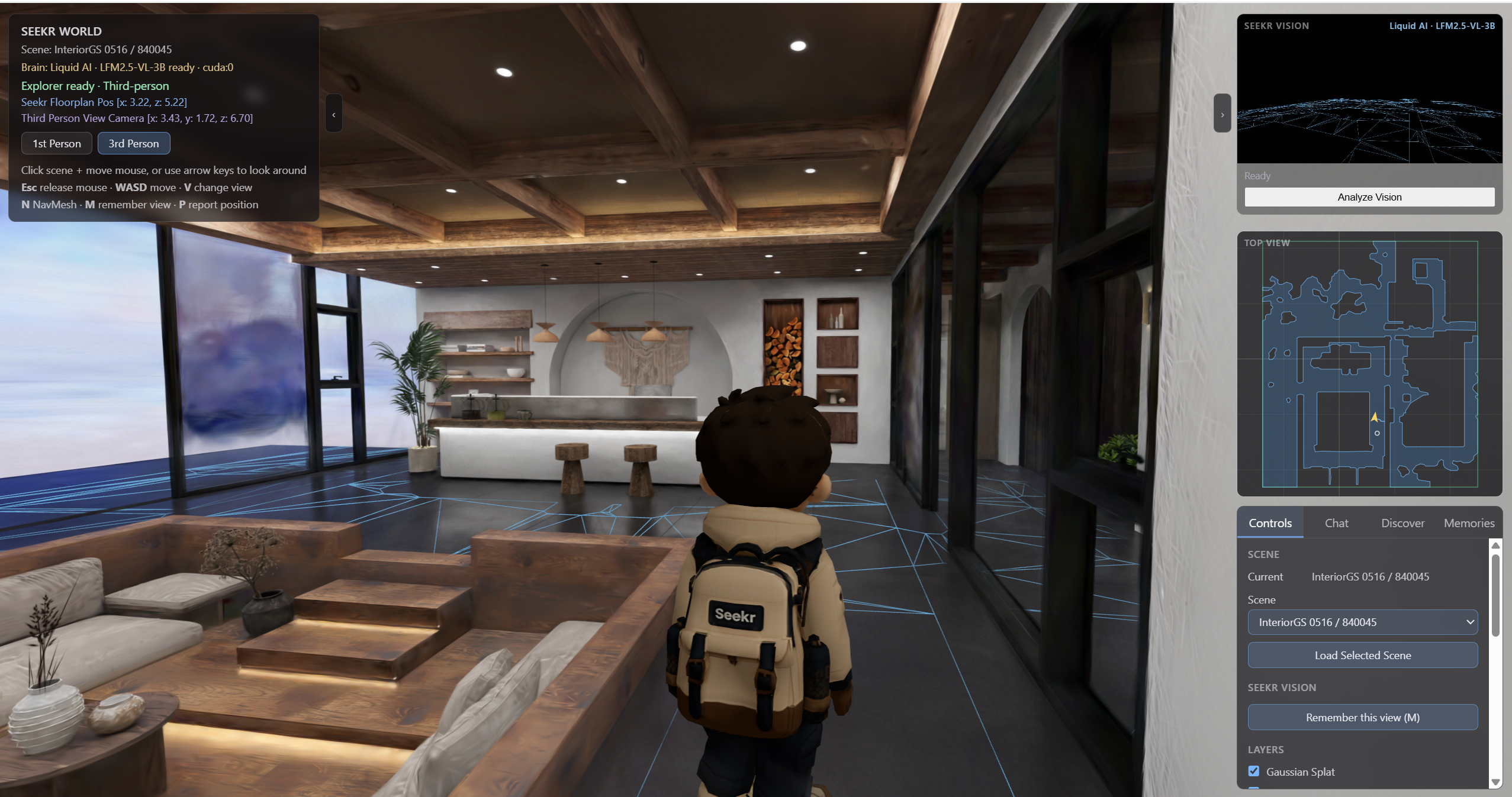
Seekr turns visual exploration into product discovery. The agent moves through photorealistic 3D environments and sees the world from its own first-person camera. **Liquid AI’s LFM2.5-VL-3B** interprets that egocentric view, identifying visible objects and describing details such as material, color, shape, finish, and style. A user can ask questions like: “Find stools like this online.” Seekr uses Liquid to convert the visible object into a precise visual shopping description, then sends that description to **Nimble** to search the live web for similar products and return clickable shopping results. Seekr can also navigate toward objects, save visual memories of interesting scenes, and turn selected memories into a generated visual postcard using **Black Forest Labs**. The result is an embodied agent that connects what it sees in a 3D world directly to real-world product discovery and shopping.
Listed tools (4)
Scroll for more NimblependingAI Dev Platforms tool
 Liquid AIpendingModel Hosting tool
 Black Forest LabspendingAI Dev Platforms tool
 memories.aipendingAI Dev Platforms tool
Robot Dojo pits two simulated Unitree G1 humanoids, karate-inspired vs taekwondo-inspired, in live MuJoCo physics on Unitree's pretrained balance policy, shown in a Three.js arena with each robot's own eye camera. Long-horizon angle: a research agent evolved each style's movement programs over dozens of physics trials, keeping compact versioned state (hypotheses, candidate lineage, held-out comparisons) instead of a growing transcript. Karate hand reach rose from 0.119 to 0.203 m on held-out seeds with zero falls; failed trials stay on record. Liquid AI: each fighter runs its own local LFM2.5-VL-450M (llama.cpp in Docker) that sees only its robot's head-camera frame and returns a schema-validated tactical intent. In a recorded bout, three accepted "approach" decisions closed the gap from 1.70 m to 0.73 m. Next: Liquid picks combos using compact opponent memory, moving to MLX on Apple Metal (0.13-0.24 s per call vs 8-16 s on CPU) and LEAP LoRA tuning on robot-eye decisions. Demo video: choreographed combos, but hits are scored from real physics contacts and a robot staggers only when a strike actually lands. Limits: the exchange sequence is scripted and the kick is not yet balance-validated. FLUX video renditions were planned but not built.
Listed tools (2)
- Liquid AIpendingModel Hosting tool
 CodexpendingAI Agents tool

We used Nimble, LiquidAI, and RawTree to build a **web app** that **recommends recipes** to users and let them select from 3 different options and then get a **video tutorial of the recipe from the web**.
Listed tools (3)
- Liquid AIpendingModel Hosting tool
- NimblependingAI Dev Platforms tool
 TinybirdpendingAI Dev Platforms tool
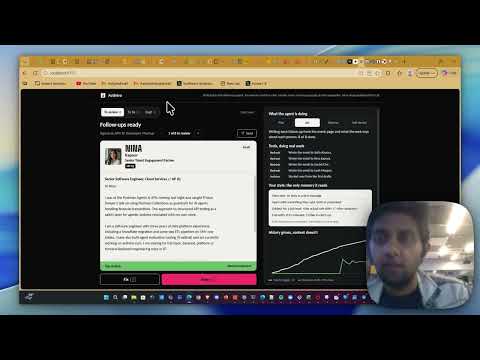
What it does: Actintro already ranks everyone at your Luma event against your goal. This agent picks up the top leads you never got to talk to, searches the web for each company's careers pages and open roles, and writes one follow-up per person. You swipe: Keep sends it to your drafts, Fix sends it back. One tap ("Shorter", "Warmer") or a typed note turns your fix into a rule on a small style card, and the rejected drafts are rewritten with it at the same time. The long-horizon part: the agent never reads its own history. Each draft reads only three small cards (event, lead, style), so what it reads per draft stays flat while the log grows. The page charts both lines live. Code checks only exact things (no em dash, no link, your exact closing line, the word limit); anything that needs judgement is a model call. Tools: Tinybird (Rawtree) stores the append-only log of every search, draft, swipe and rule, and feeds the live feed and chart; no model reads it back. Nimble does the live web search behind each card's sourced facts. Black Forest Labs FLUX generates the faces of the made-up people in the public sample room (real companies, invented names). We also measured Liquid AI's LFM2.5-1.2B locally as a filter; it was fast but not accurate enough (47/100), so it is out. AWS Bedrock writes the drafts. Repo: github.com/vidiyala99/actintro-followups
Listed tools (3)
- NimblependingAI Dev Platforms tool
- TinybirdpendingAI Dev Platforms tool
- Black Forest LabspendingAI Dev Platforms tool
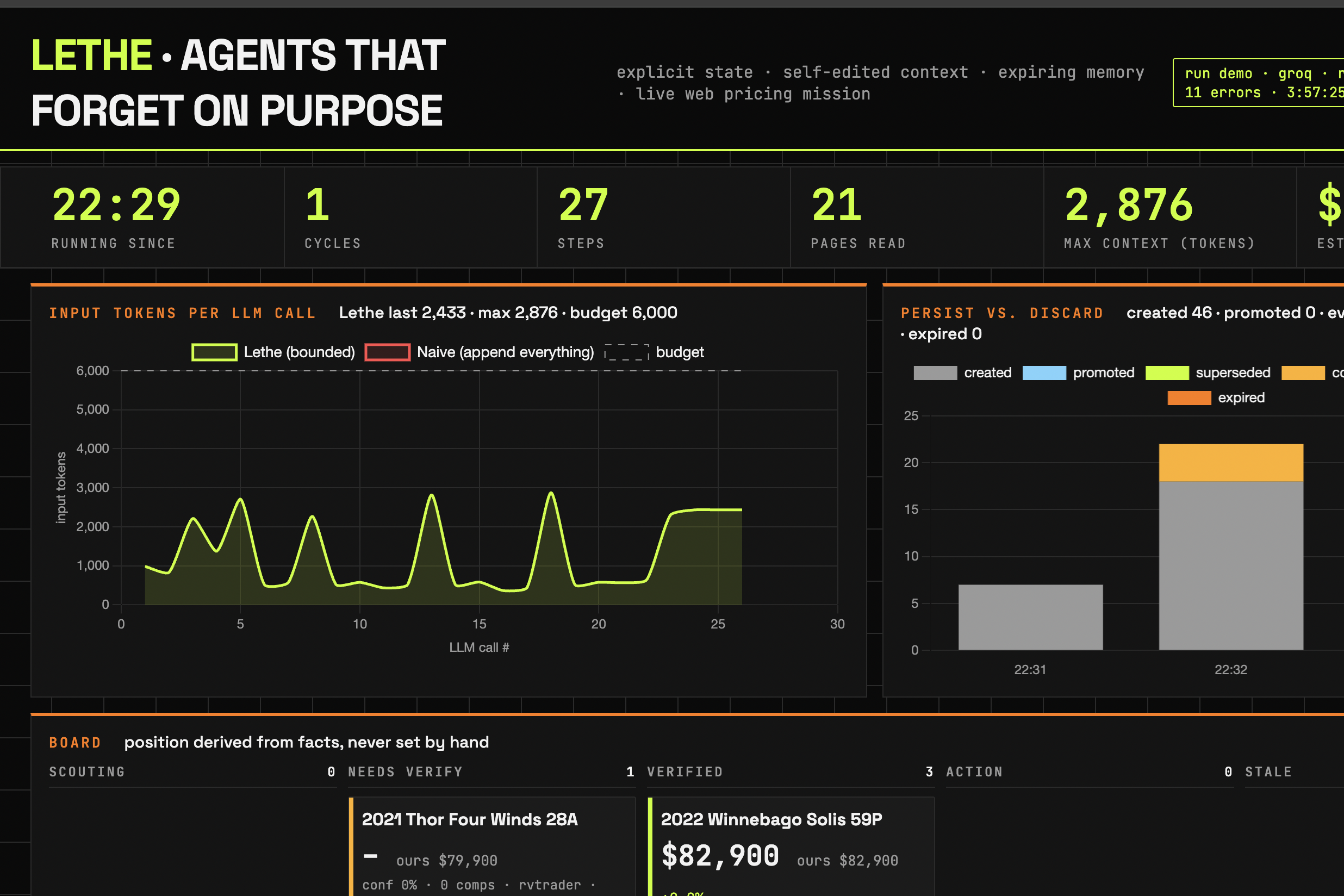
Long-horizon agents drown in their own history: every observation gets appended, every call gets slower and costlier, and stale context corrupts decisions. Lethe fixes this with three rules. (1) Explicit mutable state: a one-page Mission Ledger the agent rewrites every cycle instead of a transcript, with a hard 6k-token cap per LLM call. (2) The agent edits its own context through tools: update_plan, record_decision, add_lesson, set_recommendation, mark_stale. (3) A clear split between persist and discard: raw pages die with the worker that read them, extracted facts carry a TTL, facts confirmed by two sources persist, and a sold listing wipes everything about it. The demo mission prices a dealership's used RVs against the live web. Scouts use Nimble to search and read listings and return a card under 200 tokens. A Liquid LFM2.5 model running locally on a laptop assigns every fact its TTL and confidence. An Auditor checks comparability and, when a strategy fails, writes a lesson and the agent switches strategy on its own. OpenAI's gpt-oss models plan and decide. All state and every event, including token counts per call, live in a RawTree database, so kill -9 followed by restart resumes in under a second with no replay. Results: max context 2,876 tokens over hours of live runs. The naive baseline (same tools, append-everything) hits the provider's wall by step 6. The dashboard shows both lines, the board, the facts being expired and contradicted, and the self-corrections.
Listed tools (4)
Scroll for more- NimblependingAI Dev Platforms tool
- TinybirdpendingAI Dev Platforms tool
- Liquid AIpendingModel Hosting tool
- CodexpendingAI Agents tool
We built a long running agent that accompanies a patient throughout their medical journey. It allows the patient or the medical provider to generate visualizations to their patients conditions. It works on device to preserve privacy for the patients and it can remember the patients questions and preferences. It also allows for editing and modifying the visualizations so that the explanation is truly accurate for the patient.
Listed tools (4)
Scroll for more- CodexpendingAI Agents tool
- Liquid AIpendingModel Hosting tool
- NimblependingAI Dev Platforms tool
- Black Forest LabspendingAI Dev Platforms tool
AgentFire is a reliability and endurance-testing platform for autonomous agents — essentially chaos engineering for AI agents. It compresses a simulated 24-hour production shift into minutes and tests whether an agent remains reliable as history and memory accumulate. In the first incident, the agent diagnoses an expired authentication credential, remediates it, and verifies recovery. RawTree stores the full flight recorder of observations, tool calls, actions, and evaluations. Liquid AI then compiles that long history into compact durable experience, reducing roughly 13,000 tokens to about 378 tokens while preserving the full audit trail. Later, a similar-looking incident occurs, but the real cause is database connection exhaustion. The agent retrieves the old authentication memory and incorrectly repeats the prior remediation, so AgentFire fails the run despite eventual recovery. After applying a general memory-safety rule — memory is evidence, not current truth — the same fire drill is rerun. The agent rejects the stale remediation, fixes the database issue, verifies recovery, and passes with zero unnecessary or unsafe actions. Nimble provides real-world incident intelligence, OpenAI powers the agent under test, RawTree provides telemetry and replay, and Liquid AI compiles durable experience.
Listed tools (5)
Scroll for more- OpenAIpendingModel Hosting tool
- Liquid AIpendingModel Hosting tool
- NimblependingAI Dev Platforms tool
- TinybirdpendingAI Dev Platforms tool
- CodexpendingAI Agents tool

HorizonCraft is a personal world builder: you chat about your life and an agent turns it into a living 3D world. Mention Tahoe and a ski chalet appears by the lake; mention Rome and a Colosseum rises under a starry sky, because it's night there. Attach a selfie and you're in the world too. Underneath is a memory layer for long-horizon agents. The agent never sees a transcript. Every prompt is rendered from a bounded typed state: placed things with coordinates, landmarks, live conditions, and facts about you. Every build stage checkpoints atomically, so killing the agent mid-generation and restarting resumes at the exact stage. Memory changes behavior: rejected things go into a failures ledger and get regenerated differently; earlier builds become landmarks later requests can reference. Sponsors: OpenAI gpt-5-mini interprets conversation into structured actions from state, not history, so prompts stay ~800 tokens at turn 100. Liquid LFM2 (1.2B, local via Ollama) handles fast decisions: naming, sizing, keep/drop, half a second each. Nimble fetches real weather, temperature and local time for any place you mention, driving sky and day/night. Black Forest Labs FLUX draws every object, and FLUX Kontext turns selfies into characters. fal.ai hosts Hunyuan3D for image-to-mesh. Rawtree records every decision and token count, feeding a memory panel that proves the context never grows.
Listed tools (5)
Scroll for more- OpenAIpendingModel Hosting tool
- Liquid AIpendingModel Hosting tool
- NimblependingAI Dev Platforms tool
- Black Forest LabspendingAI Dev Platforms tool
- TinybirdpendingAI Dev Platforms tool
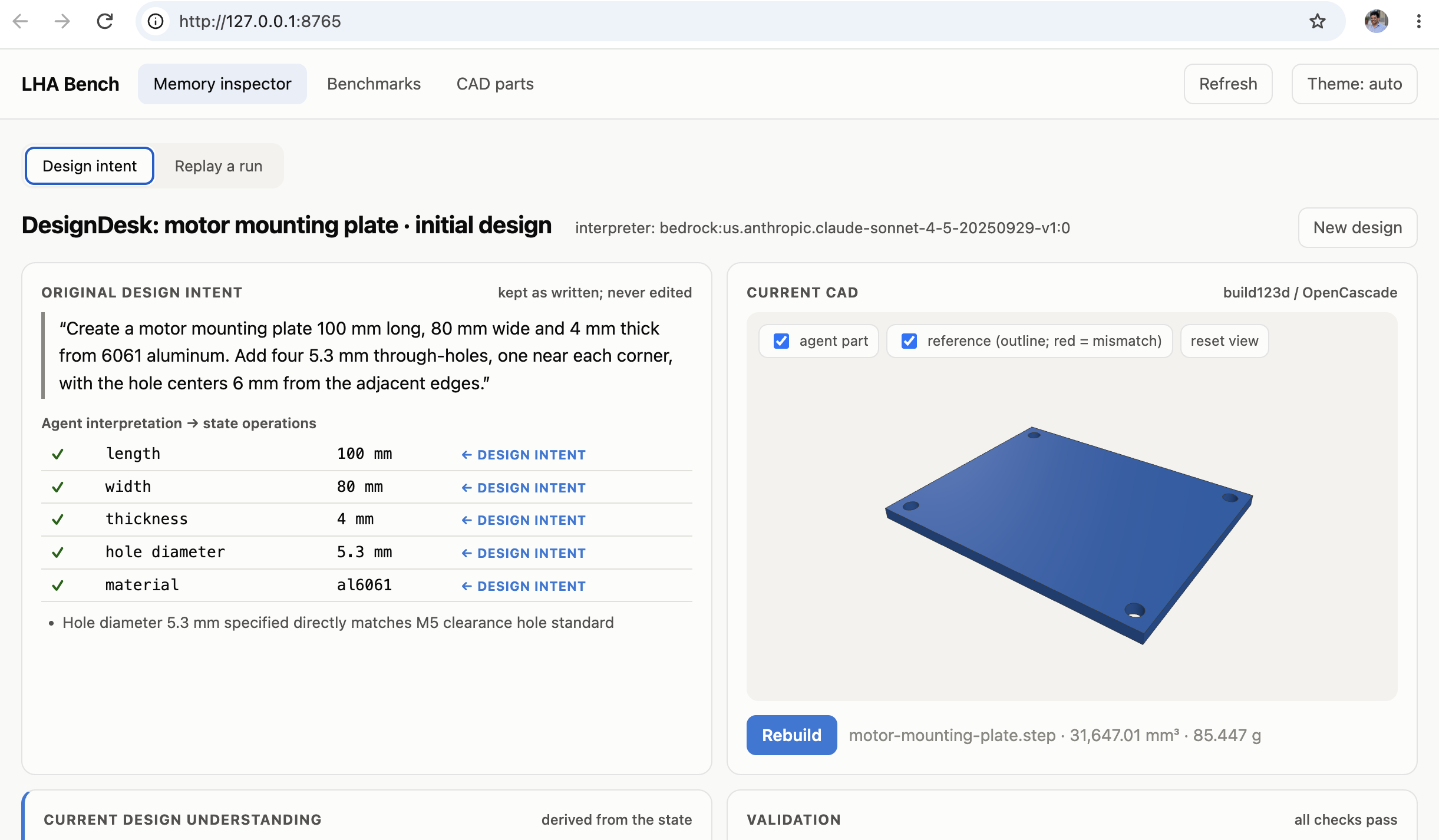
LongHorizonAgent is an AI agent architecture designed to work reliably across hundreds or thousands of steps without continuously growing its context. Instead of replaying the full conversation history, it maintains a small, structured working state containing what is true now, archives outdated or evicted information, and recalls it only when needed. The project demonstrates this approach through DesignDesk, an AI mechanical-engineering environment where natural-language design intent is converted into structured state, updated through engineering changes, and used to generate and validate real CAD geometry with build123d and OpenCascade. A Memory State Inspector makes state changes, archived facts, recalls, provenance, and context savings visible, while AWS Bedrock provides the main reasoning model, Nimble provides web tools, and Tinybird provides telemetry and analytics. The core idea is simple: **History grows. State doesn’t have to.**
Listed tools (3)
- Liquid AIpendingModel Hosting tool
- TinybirdpendingAI Dev Platforms tool
- NimblependingAI Dev Platforms tool

Banks quietly reserve their best rates for new money. Stay loyal and you get the worst of it. AutoSvr is an agent that checks the market every day and keeps your deposit at whichever FDIC-insured partner bank is paying the most. How it works. Nimble runs a headless crawl of three rate sources (depositaccounts.com, bankrate.com, nerdwallet.com), waiting for each rate table to actually render before capturing the HTML. A Liquid AI LFM, called through OpenRouter, reads that markup and returns structured rate rows — so there are no brittle per-site scrapers to maintain. The sweep engine then applies four rules: the bank must carry FDIC or NCUA insurance, a new rate must beat the current one by at least 25 basis points, transfers initiate only on banking days, and interest books exactly once per calendar day. Everything lands in RawTree/ClickHouse as rate_observations, sweep_events and daily_accruals, and a SQL read layer compounds a blended APY at one row per day. Why 25 basis points. A transfer costs one to three days of interest in settlement, so chasing every basis point loses money. When AutoSvr holds, it says why: the demo account sits at 4.44% with 4.62% available — an 18bp gap that does not clear the threshold. What you see. A live balance, every bank that has held your deposit with its FDIC certificate number and the rate it paid each day, statements, and withdrawal with no lockup and no fee.
Listed tools (3)
- Liquid AIpendingModel Hosting tool
- Black Forest LabspendingAI Dev Platforms tool
- NimblependingAI Dev Platforms tool
Need another build idea?
Curated project ideas to help you choose a stack. Sign in to create a plan; publish your project when you have work to share.
Launch-week proof page for an agent tool
Turn a fresh repo, demo, Show HN, or hackathon launch into a public proof page with stack notes, launch context, and real build evidence.
Suggested tools
Semantic search over product data
Build a search experience that understands intent, supports filters, and can move from local prototype to hosted vector search.
Suggested tools
Agent workflow for repeatable tasks
Route a task through planning, tool calls, validation, and human review without losing observability.