Anonymous builderabout 2 months agoJudging locked: Event buildWinner · 3rd Place Best use of Tinybird

Livik

Livik is an AI agent that optimizes models for on-device hardware, running unattended for hours, days or weeks: it rewrites GPU kernels, tests every attempt on the real device, and remembers everything it learns so it never repeats itself and reuses its best kernels on new models.

Check your own project

Community votes recognize the build and do not affect official judging.
Review the project

Start with the source code, then open the demo or video if available.

View GitHub repository
Project description
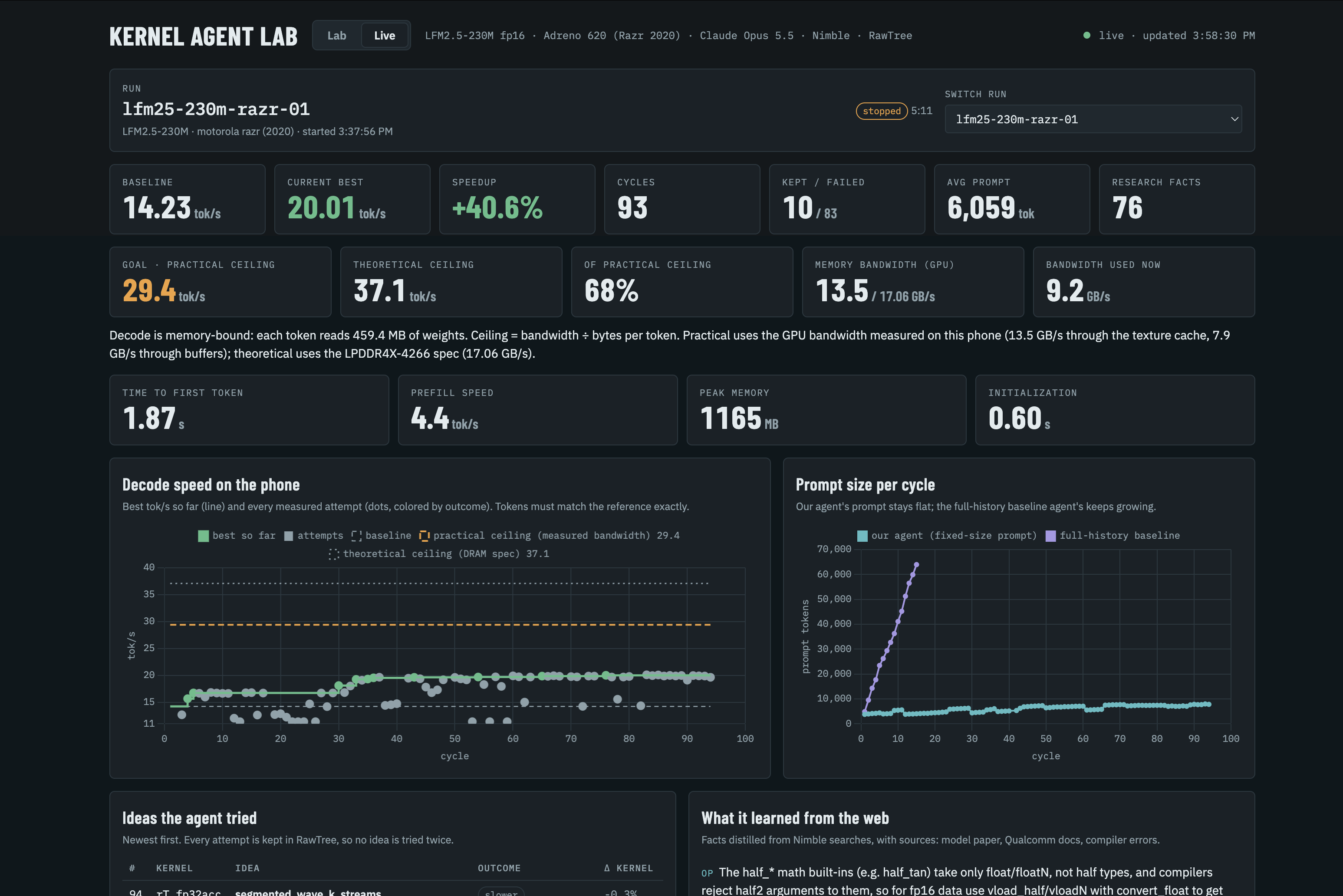
What it does: Livik profiles an LLM running on an Android phone, finds the slowest GPU kernels, and rewrites them one attempt at a time. Every attempt runs the full model on the device and must produce exactly the same tokens; only faster kernels are kept. On a 2020 Motorola Razr, Liquid AI's LFM2.5-230M went from 14.2 to 20.0 tok/s (+41%), 68% of the device's measured memory-bandwidth ceiling, beating the stock int8 engine at full fp16 precision. Long horizon without drowning in history: each cycle is stateless. The prompt is rebuilt from memory at a fixed ~6k tokens after 90+ cycles, while a full-history agent hit 64k tokens in 15. Kill it anytime; it resumes where it left off. RawTree (Tinybird): every worker call, device run, idea, kernel diff, research fact and benchmark is an event in RawTree. The agent reads its tried ideas, facts and best kernels back with SQL each cycle, which powers resume and warm start: LFM2.5-350M, never optimized before, jumped from 12.4 to 15.6 tok/s in under 2 minutes with zero LLM calls by reusing 230M's winners. Nimble: when the device's compiler rejects a kernel, the agent searches the web on its own (model paper, Qualcomm Adreno docs, the exact error) and stores distilled facts with sources. Liquid AI: LFM2.5-230M, 350M and VL-450M are the models. Claude Opus 5.5 on Vertex AI writes the kernels. The Lab web app runs, benchmarks and streams device logs.
Tools used